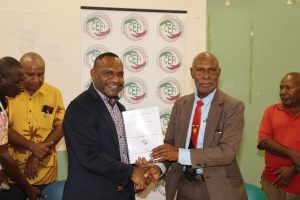
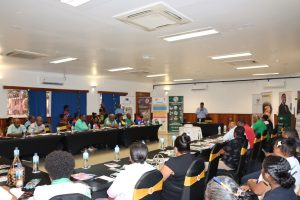
Newly accredited financial literacy trainers have been urged to become champions of responsible money management and financial awareness across Papua New Guinea.
The call was made during the Training of Trainers Financial Literacy Expression of Interest Mini Graduation held at the Centre for Excellence in Financial Inclusion (CEFI) office on Friday, 6 March. The seventeen (17) participants were recognised for completing the programme designed to strengthen financial education across communities.
Speaking at the event, the Assistant Governor of the Financial System Development and Innovation Group at the Bank of Papua New Guinea, Mr. George Awap, said he was impressed by the participants’ commitment to improving their financial knowledge and discipline.
Mr Awap said he was encouraged that the participants had chosen to attend the programme, describing financial management as a skill that required both knowledge and discipline. He emphasised the importance of prudent money management and warned that cash could easily be lost without careful planning.
“Money is like a liquid that you try to catch in your pocket… it can disappear within minutes,” he said.
Mr Awap noted that Papua New Guinea continued to face challenges with a large number of people who remained unbanked. However, he stressed that financial education and empowerment could help transform lives, particularly in rural communities.
He urged participants to become role models and to use the knowledge they had gained to guide others towards responsible financial behaviour.
“Managing both income streams and expenditure patterns will get you on the right path. I congratulate you all for attending these courses,” he said.
Also addressing the gathering was the Assistant Governor of the Financial System Regulations and Supervision Group at the Bank of Papua New Guinea, Mrs. Sabina Deklin, who encouraged participants to use their knowledge to promote safe financial practices.
Mrs Deklin said financial literacy was a powerful tool that could help people make better decisions about how they earn, save and spend their money.
“Knowledge is power. Use that to influence how people actually plan and spend their money,” she said.
She also warned participants about fraudulent investment schemes that promised unrealistic returns, cautioning the public to remain vigilant.
“If someone tells you that you will be earning 300 or 400 per cent interest, that is a red flag,” Mrs Deklin said.
She advised people to conduct financial transactions only with regulated institutions such as banks, microfinance institutions, savings and loans societies, or licensed payment service providers to ensure their money was protected.
The Acting Executive Director of the Centre for Excellence in Financial Inclusion, Mr. Peter Samuel, said the training programme represented another step in strengthening financial inclusion efforts in the country.
Mr Samuel acknowledged the support of stakeholders, including representatives from the Bank of Papua New Guinea and participants who successfully completed the course.
He explained that CEFI was established in 2010 to address limited access to financial services for the majority of Papua New Guinea’s population.
“CEFI was created particularly to address the fact that nearly 80 per cent of our population did not have access to formal banking services or financial literacy training,” he said.
Mr Samuel noted that significant progress had been made over the years, with the number of bank accounts increasing from about 800,000 to approximately 4.6 million nationwide. He said this growth reflected the success of financial inclusion initiatives implemented by CEFI and its partners.
However, he emphasised that the newly trained participants now carried an important responsibility to extend financial knowledge to others.
“You are now accredited trainers. The challenge is for you to go back and ensure that the knowledge you have gained influences your workplace, communities and families,” he said.
Mr Samuel added that building a strong savings culture remained one of the country’s major challenges. He encouraged the trainers to help drive behavioural change through financial education and responsible financial practices.
He further noted that the new trainers would be included in CEFI’s database and could be called upon to assist with financial literacy training programmes across Papua New Guinea.
Meanwhile, invited guest , the Managing Director of the Investment Promotion Authority, Clarence Hoot, urged participants to apply their newly acquired knowledge in practical ways.
Mr Hoot encouraged them to share what they had learned with their families and communities and emphasised the importance of integrity when managing financial resources.
“Take what you understand clearly and extend it to your families and communities,” he said, adding that honesty, accountability and transparency were essential for good governance in Papua New Guinea.
In his closing remarks, the Chairman of the National Housing Commission, James Wong, who also attended the weeklong training and was presented with his certificate, described the programme as valuable and informative.
Mr Wong said the training had helped participants understand financial terminology and practical financial management techniques.
“You may get money… but you may not survive if you do not budget or invest it properly,” he said.
He also called on government departments and institutions to invest in financial education for their staff, stressing that building financial capability within organisations could have long-term benefits.
“Every single member of National Housing Corporation… will be trained as training of trainers in financial literacy,” he said.
Mr Wong encouraged leaders to lead by example and to begin financial education initiatives within their own organisations.
“Believe in yourself and trust in God. Start small, grow it,” he said.
Representing the participants, Kenneth Bale, who spoke on behalf of the male trainees, reflected on how the training had helped him better understand financial management.
“I wish I knew then what I know now,” Mr Bale said, noting that lessons learned from overcoming personal debt had given him a new perspective on financial discipline.
He said the knowledge gained from the programme would help support families and communities, particularly in East New Guinea, and could potentially benefit thousands of people.
Mr Bale also acknowledged the support of programme organisers and stakeholders, stating that their efforts could positively impact “1,000 families, about 3,000 people”.
Speaking on behalf of the female participants, Anastasia Kukuna expressed appreciation to CEFI for providing training on saving and budgeting.
“This training has given us not only knowledge, but also the skills and confidence to educate others about the importance of saving,” she said.
Ms Kukuna added that the newly trained participants were committed to sharing financial literacy knowledge within their communities and helping to build a stronger culture of saving across Papua New Guinea.
Photos Caption: Images from the mini graduation.


Ends.
About CEFI
CEFI was established under the Association Incorporation Act and officially launched on the 24th of April 2013. CEFI was endorsed by PNG’s National Executive Council (NEC) as the industry apex organization for coordinating, advocating and moniotoring all financial inclusion activities in PNG.
CEFI’s vision, mission and values focus on financial inclusion and literacy, poverty elimination and the promotion of vibrant financial institutional operation in Papua New Guinea.
Visit our website – www.thecefi.org
Media Contact:
Mr. Leslie Omaro
Communication Officer
Phone: 7464 5678
Email: lomaro@thecefi.org